

Your property tax bill just arrived, and the number makes your stomach drop. How did your taxes jump $2,000 in a single year? Your house didn’t suddenly double in value. You didn’t add a pool or finish the attic. Yet here you are, staring at a bill that feels completely disconnected from reality.
You’re not alone, and you’re not powerless. Thousands of Tarrant County texas property owners face inflated appraisals every year. The difference? Some accept the bill and pay it. Others fight back and win.
Protesting your property taxes isn’t some insider secret reserved for the wealthy or well-connected. It’s a legal right built into Texas law specifically to protect you from unfair valuations. The Tarrant Appraisal District determines your home’s worth, but they’re not infallible. Mistakes happen. Overvaluations happen. And when they do, you have every right to challenge them.
This guide walks you through the entire protest process from start to finish. You’ll learn exactly when and how to file, what evidence wins cases, and how to prepare for your hearing. We’ll cover the exemptions that stack on top of protest savings, common mistakes that sink good cases, and when professional help makes financial sense.
The May 15 deadline is real and unforgiving. But between now and then, you have options. You have power. And you have a clear path to potentially saving hundreds or thousands of dollars every year going forward.
Your property tax bill doesn’t have to be something you simply accept. Let’s turn that frustration into action.
Understanding Property Tax Protests in Tarrant County

Property tax protests in Tarrant County give you a legal right to challenge your home’s appraised value. Every year, the Tarrant Appraisal District determines what your property is worth. This value directly affects how much you pay in property taxes. If you believe their number is too high, you can file a protest.
Think of it like questioning a restaurant bill that seems wrong. You’re not doing anything shady—you’re simply exercising your right as a property owner. The process is built into Texas law specifically so homeowners can ensure they’re being taxed fairly.
Here’s what makes Tarrant County property tax protests accessible to everyone. You don’t need to be a real estate expert or hire an attorney. Thousands of Tarrant County homeowners protest their property taxes every year. Many do it themselves and win reductions.
A property tax protest challenges one thing: the property tax value assigned to your home. You’re essentially saying, “My house isn’t worth what you claim.” If you can prove your case with solid evidence, the Appraisal Review Board may lower your value. A lower appraised value means lower property taxes.
The beauty of this system is that for most homeowners there’s effectively no downside to protesting. In typical residential cases, your value either stays the same or goes down. The Appraisal Review Board does have the authority to increase a value in some situations. However, that’s relatively uncommon when you present honest, well-supported evidence.
Most people don’t realize they have this right. They receive their Notice of Appraised Value in the mail, feel frustrated by the increase, but assume there’s nothing they can do. That’s simply not true. The protest process exists because Texas lawmakers recognized that appraisals aren’t always accurate.
How Tarrant County Property Taxes Are Calculated
Understanding how property taxes are calculated helps you see exactly where your money goes. Calculating property taxes is straightforward. This figure is calculated by subtracting exemptions from your assessed value, then multiplying by the tax rate.
Let’s break that down. The Tarrant Appraisal District determines your property tax value (market value) each year. This amount becomes your assessed value. Next, local taxing entities—like your school district, city, and county—set their individual tax rates. These rates get combined into one total rate for your area.
Here’s a simple example. Say your home has an assessed value of $300,000. Your combined tax rate is 2.5%. Your calculation looks like this: $300,000 × 0.025 = $7,500 in annual property taxes before exemptions.
TARRANT APPRAISAL DISTRICT
Notice of Appraised Value – Tax Year 2025
But here’s where it gets interesting. Your taxable value might be different from your assessed value. If you have a homestead exemption, that reduces your taxable value. So if you have a $140,000 homestead exemption (the current amount as of 2025), you’d only pay taxes on $160,000 instead of $300,000.
The combined tax rate varies depending on where you live in Tarrant County. Fort Worth residents might pay a different rate than someone in Arlington or Southlake. School districts make up the largest portion of your property tax bill—typically around 50-60% of your total.
Every taxing entity in your area—school district, city, county, hospital district—adds their piece to your tax burden. When the Tarrant Appraisal District raises your appraised value, every one of these entities collects more from you.
That’s why protesting matters. Even a small reduction in your appraised value saves you money across all these entities.
Why You Should Protest Your Property Taxes in Tarrant County

You should protest your property taxes because home values in Tarrant County have skyrocketed in recent years. The appraisal district often overvalues properties, meaning you’re paying more than you should. A successful protest delivers a property tax reduction that saves you money every single year.
The real benefit is savings over time. If you reduce your appraised value by $50,000 this year, you save money not just in 2025 but in future years too. That $50,000 reduction at a 2.5% tax rate saves you $1,250 annually. Over five years, that’s $6,250 back in your pocket.
The process favors homeowners who speak up. The Tarrant Appraisal District reviews nearly 2 million properties. Errors happen. Your neighbor’s house might be valued lower than yours despite being nearly identical. Without protesting, that imbalance continues indefinitely.
Think about your tax burden this way. Every dollar you overpay in property taxes is a dollar you can’t invest elsewhere. It’s money that could fund home improvements, retirement savings, or your children’s education. Protesting ensures you’re only paying what’s legally required—nothing more.
Thousands of Tarrant County homeowners protest successfully every year. You’re not asking for a favor. You’re exercising a legal right built into Texas property tax law.
When Is the Deadline to File a Property Tax Protest?

The deadline to file a property tax protest in Tarrant County is May 15 or 30 days after your Notice of Appraised Value is mailed—whichever date comes later. This is the most critical date in the entire protest process.
Most homeowners receive their Notice of Appraised Value in April. If yours arrives on April 1, you have until May 15 to file a protest. But if TAD mails your notice on May 1, you get 30 days from that date, giving you until May 31.
Mark your calendar as soon as you receive that notice. Missing the property tax deadline means you’re stuck with the appraised value for the entire year. You can’t protest late unless you meet very specific exceptions, like being deployed in the military or experiencing a natural disaster.
Here’s why timing matters so much. Once the deadline passes, your assessed value becomes final. Even if you discover comparable properties proving your value is too high, you can’t do anything about it until next year. That’s 12 months of overpaying.
The May 15 deadline applies to most Tarrant County homeowners. However, always check your actual notice date. TAD must give you at least 30 days from when they mail the notice. Count carefully if your notice arrives in late April or early May.
Don’t wait until the last minute to file a protest. Online systems can slow down as the deadline approaches. Thousands of other homeowners are trying to submit their protests too. Give yourself at least a week before May 15 to avoid technical issues or delays.
If you’re unsure when your notice was mailed, check the postmark date on the envelope. Keep that envelope as proof of when you received official notification.
How to File a Notice of Protest in Tarrant County

Filing a Notice of Protest in Tarrant County starts with Form 50-132. This is the official document that initiates your protest with the Tarrant Appraisal District. You have three ways to file: online through the TAD portal, by mail, or in person at their office.
The online protest method is the fastest and most convenient. Visit the TAD portal on the Tarrant Appraisal District website. You’ll need your property account number, which appears on your Notice of Appraised Value. The system walks you through each step and confirms receipt immediately.
Form 50-132 asks for basic information: your name, property address, contact details, and the reason you’re protesting. You’ll check a box indicating why you disagree—typically “value is unequal compared with other properties” or “value exceeds market value.” Don’t worry about providing evidence yet. That comes later.
After you file a protest, TAD sends confirmation within a few days. This confirmation includes your protest number and information about next steps. Keep this documentation. You’ll need it to track your case and prepare for your hearing.
Here’s what you’re NOT doing when you file: You’re not presenting evidence yet. You’re not arguing your case. You’re simply notifying TAD that you disagree with their value. Think of Form 50-132 as raising your hand to say, “I want to be heard.”
Many property owners choose to hire professionals to handle their protest. This ensures all deadlines are met correctly and your case is positioned for the best possible outcome from the start. Professional representation can navigate the technical requirements while you focus on your daily responsibilities.
Understanding the Tarrant Appraisal District (TAD) Process
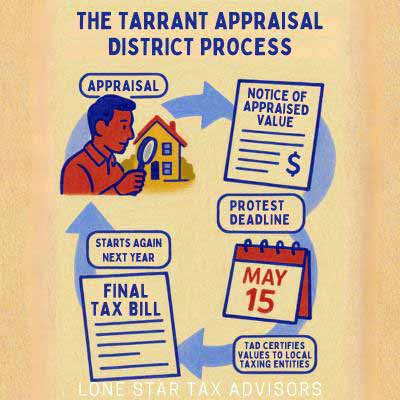
The Tarrant Appraisal District follows a structured annual cycle that determines your property’s value. Understanding this process helps you know when and why your appraised value changes each year.
TAD appraisers review properties throughout the year. They look at recent sales data, building permits, and physical inspections to determine market value. By spring, they calculate what they believe each property is worth for the upcoming tax year.
You receive your Notice of Appraised Value between April and early May. This notice shows your property’s current value, any exemptions you have, and the deadline to protest. It also includes your estimated taxes based on last year’s tax rates—though actual rates may vary.
The notice breaks down your property value into land and improvements. Land value reflects what your lot alone is worth. Improvements include your house and any other structures. TAD values these separately because land and building values often change at different rates.
After the protest deadline passes, TAD certifies values to local taxing entities. School districts, cities, and counties then set their tax rates based on these certified values. Your final tax bill arrives around October or November with a January 31st due date, and you will have various payment options available.
The entire process repeats annually. This is why property owners need to stay vigilant. A value increase you don’t catch this year becomes your baseline for next year. Protesting keeps your assessed value in check and prevents compounding overvaluations.
Understanding each step of the TAD process helps you recognize opportunities to challenge unfair valuations. Many property owners find the technical details and strict timelines overwhelming. Professional representation ensures nothing falls through the cracks during this annual cycle.
What Happens During an Informal Review?

An informal review gives you a chance to resolve your protest without attending a formal hearing. After you file a protest, TAD may offer an informal review appointment. This is essentially a negotiation meeting with an appraisal district staff member.
You present your evidence during the informal review just as you would at a formal hearing. Bring your comparable sales, photographs, or repair estimates. The TAD representative reviews your information and may adjust your value on the spot if your evidence is convincing.
Informal reviews typically happen by phone or through the online portal. You skip the wait for a scheduled ARB hearing. Many property owners resolve their protests through informal review and never need to attend a formal hearing.
However, you’re not required to accept the outcome. If TAD offers a reduction but you believe you deserve more, you can decline and proceed to your scheduled hearing. Think of informal review as an optional first step that might save you time.
Not all protests receive informal review offers. TAD prioritizes cases based on their workload and the specifics of each protest. If you don’t receive an offer, don’t worry—you’ll still get your formal hearing before the Appraisal Review Board.
Some property owners skip informal review entirely. They prefer presenting their case to the board rather than negotiating with district staff. That’s perfectly fine. The informal review is an opportunity, not a requirement.
If you do participate and reach an agreement, TAD sends written confirmation of your new value. This agreement is binding for the current tax year. Your protest is considered resolved at that point.
What Happens at an ARB Hearing?
Your ARB hearing is a formal but straightforward proceeding. You’ll present your case to a panel of typically three board members. They’re volunteers appointed to review property tax protests and make fair decisions based on evidence.
The hearing usually lasts 15 to 30 minutes. You’ll be notified of your scheduled time in advance. Hearings can happen in person at the appraisal district office or virtually through online platforms. Arrive early if attending in person or log in a few minutes before your virtual appointment.
A TAD representative will also be present. They may present their own evidence supporting the current value. This isn’t adversarial—it’s simply both sides presenting information so the board can make an informed decision.
You’ll present your evidence first in most cases. Explain why you believe your appraised value is too high. Walk through your comparable properties, showing how similar homes sold for less. Point out any property defects documented in your photographs. Keep your presentation clear and focused.
Board members may ask questions. They might inquire about specific comparable sales you chose or ask for clarification on property conditions. Answer directly and honestly. If you don’t know something, it’s okay to say so.
After both sides present, the board deliberates. Sometimes they decide immediately. Other times they need additional time to review evidence. You’ll receive their written decision by mail within a few days.
The board has three options: keep your value as-is, reduce it, or, in rare cases, increase it. Most decisions either maintain the current value or grant a partial reduction. Complete agreement with your suggested value happens but isn’t common.
How to Appeal an ARB Decision Through District Court or Binding Arbitration
If you disagree with the ARB’s decision, you have two appeal options: district court or binding arbitration. You must file your appeal within 60 days of receiving the board’s written decision. Missing this deadline means the ARB decision becomes final.
District court appeals follow a formal legal process. You file a lawsuit in Tarrant County district court challenging the board’s valuation. The case proceeds like other civil litigation with discovery, evidence submission, and potentially a trial. A judge or jury reviews all evidence and determines your property’s value.
The district court route offers the most comprehensive review. You can present new evidence not shown at your ARB hearing. Testimony from professional appraisers carries significant weight. However, court cases take time—often six months to over a year for resolution.
Binding arbitration provides a faster alternative. An independent arbitrator reviews your case and makes a final decision. The process is less formal than court but still requires presenting evidence. Most arbitration cases resolve within a few months.
Cost considerations matter for both options. District court requires filing fees and often legal representation. Attorney fees can add up quickly. Binding arbitration has its own fees, though typically lower than full litigation costs.
The property value threshold influences your choice. For properties valued under $5 million, both options are available. Different rules apply to higher-value properties, so check current requirements.
Each path has strategic advantages. District court decisions can set precedents for future years. Arbitration delivers quicker resolution, but the decision only applies to the current tax year. Neither option guarantees a better outcome than the ARB provided.
Most property owners who appeal hire experienced legal counsel. The technical requirements and formal procedures make professional guidance valuable for protecting your interests.
Tarrant County Property Tax Exemptions That Can Lower Your Bill
Property tax exemptions reduce your taxable value, which directly lowers your annual tax bill. Unlike protesting your appraised value, exemptions are permanent benefits you receive every year once approved. Understanding which exemptions you qualify for can save you thousands of dollars.
**Important Update:** In November 2025, Texas voters approved significant increases to property tax exemptions. The general homestead exemption increased from $100,000 to $140,000, and the over-65/disability exemption increased from $10,000 to $60,000. These changes apply retroactively to the 2025 tax year, meaning they affect your current tax bill. Seniors and disabled homeowners now receive a combined total of $200,000 in school district exemptions.
General Residential Homestead Exemption
The homestead exemption is the most common and applies to your primary residence. You must own and occupy the property as your main home on January 1 of the tax year. This exemption reduces your taxable value by $140,000 for school district taxes as of 2025.
Different taxing entities offer varying exemption amounts. School districts provide the largest homestead exemption benefit. Cities, counties, and other local taxing entities may offer additional reductions. These stack together for maximum savings.
You only need to apply once. The exemption automatically renews each year as long as you continue living in the home. If you recently purchased your home, apply as soon as possible to receive benefits for the current tax year.
Over 65 Exemption
Homeowners aged 65 or older qualify for an additional $60,000 exemption on top of the general homestead exemption (as of 2025). Combined with the $140,000 general homestead exemption, seniors receive a total of $200,000 in exemptions from school district taxes. This exemption also includes a valuable tax ceiling that freezes your school district taxes at the current amount—they can’t increase even if your property value rises.
Apply for the over-65 exemption during the year you turn 65. The benefit starts immediately upon approval. If one spouse is 65 or older, the entire household qualifies. The tax ceiling transfers to a surviving spouse, protecting them from tax increases.
This exemption delivers long-term value. As property values and tax rates climb in Tarrant County, your frozen school taxes remain constant. That protection becomes more valuable each year.
Disability Exemption
The disability exemption offers similar benefits to the over-65 exemption, providing an additional $60,000 exemption on top of the general homestead exemption (as of 2025). You must receive disability benefits from Social Security to qualify. Like the over-65 exemption, this includes both the reduced taxable value and a school tax ceiling that freezes your school district taxes.
Documentation proving your disability status is required when applying. The exemption continues as long as you remain qualified under Social Security guidelines. You can have both the general homestead exemption and disability exemption simultaneously. However, you cannot claim both the over-65 exemption and disability exemption from the same taxing unit—you must choose one or the other.
Common Mistakes to Avoid When Protesting Property Taxes
Missing the May 15 deadline is the most costly mistake homeowners make. Once the deadline passes, you’re stuck with your appraised value for the entire year. Set reminders as soon as your notice arrives. Don’t wait until the last few days to file.
Choosing poor comparable properties weakens your entire case. Your three-bedroom ranch can’t be compared to a two-story colonial with five bedrooms. Focus on properties that closely match your home’s size, age, condition, and neighborhood.
Claiming overvaluation without supporting evidence accomplishes nothing. Saying “my house isn’t worth that much” carries no weight. The board needs data—actual sales prices of similar homes proving your market value is lower. Opinions don’t win protests. Facts do.
Ignoring property condition creates missed opportunities. Many homeowners don’t document obvious defects. That cracked foundation or 20-year-old roof impacts value. Take clear photographs and get repair estimates from licensed contractors.
Confusing unequal appraisal with overvaluation hurts some cases. These are different protest grounds. Overvaluation means your value exceeds market value. Unequal appraisal means your home is valued higher than comparable properties. Choose the right argument for your situation.
Failing to request the appraisal district’s evidence can weaken your case. You can request their evidence up to 14 days before your hearing. If you make this request, the district cannot use any evidence they didn’t provide to you on time.
Attending hearings unprepared wastes everyone’s time. Know your numbers. Understand your comparables. Be ready to answer questions. Preparation builds the confidence you need to present effectively.
Should You Hire a Property Tax Consultant to Protest?
Hiring a property tax consultant depends on your comfort level with the process and the complexity of your case. Many homeowners successfully protest on their own for straightforward situations. Others prefer professional expertise to maximize results and avoid mistakes.
Consultants bring experience that most homeowners lack. They know exactly what evidence the Appraisal Review Board finds compelling. They understand how to select the strongest comparable properties and present data in the most persuasive format. Years of handling hundreds of cases give them insights you simply can’t gain from one protest.
The time investment matters for busy professionals. Researching comparable sales takes hours. Preparing evidence packets requires attention to detail. Attending hearings means taking time off work. Consultants handle everything while you focus on your career and family.
Cost structure varies among firms. Many consultants work on contingency with flexible payment options—they only get paid if they reduce your value. You pay a percentage of your first-year tax savings. No reduction means no fee. This aligns their interests with yours and removes financial risk from hiring help.
Complex properties benefit most from professional representation. Unique homes without clear comparables need sophisticated analysis. Commercial properties require specialized knowledge. High-value estates involve substantial money, where expertise pays for itself many times over.
Consider your potential savings versus the consultant’s fee. If your home’s value increased by $100,000 and a consultant can reduce it by $75,000, the tax savings likely exceed their fee significantly. The math often strongly favors professional representation.
Consultants also protect you from common errors. Choosing poor comparables, failing to request the appraisal district’s evidence in advance, or presenting information ineffectively can doom your case. Professionals navigate these requirements smoothly.
Frequently Asked Questions About Tarrant County Property Tax Protests
How to protest property taxes in Tarrant County, Texas?
File Form 50-132 through the TAD portal, by mail, or in person before the May 15 deadline. You’ll need your property account number from your Notice of Appraised Value. After filing, gather evidence and prepare for either an informal review or an ARB hearing.
Are property tax protest companies worth it?
Property tax protest companies are worth it if you want professional expertise without the time commitment. They work on contingency, so you only pay if they reduce your value. For complex properties or busy professionals, the tax savings typically exceed their fees significantly.
Is it worth protesting property taxes in Texas?
Protesting property taxes in Texas is worth it because there’s zero financial risk and substantial potential savings. A $50,000 value reduction saves $1,250 annually at a 2.5% tax rate. Those savings continue year after year, making even a small reduction valuable over time.
What evidence is needed to protest property taxes in Texas?
You need comparable sales showing similar homes sold for less than your appraised value. Photographs documenting property defects strengthen your case. Repair estimates from licensed contractors prove measurable issues. Property records showing incorrect square footage or features also serve as strong evidence.
How can I lower my property taxes in Tarrant County?
Lower your property taxes by protesting your appraised value annually and applying for all exemptions you qualify for. The homestead exemption, over-65 exemption, and disability exemption all reduce your taxable value. Protesting catches inflated appraisals, while exemptions provide permanent tax relief.